Home Safety Assessment
Most families wait for a fall before they think seriously about home safety. It's understandable. Life is busy, and when nothing has gone wrong yet, it's easy to assume nothing will. But that moment when a parent grabs the towel bar instead of a grab bar, or catches a toe on a threshold they've crossed a thousand times, tends to change everything fast.
A professional home safety assessment is a way to get ahead of that moment. It's not a home inspection, and it's not medical care. It's a room-by-room evaluation of how your home is working for the person living in it right now, and how it will need to work five or ten years from now.
What a Professional Assessment Actually Involves
A home safety assessment conducted by a Certified Aging-in-Place Specialist (CAPS) is different from what most people imagine. It's not someone walking through your house with a clipboard looking for obvious hazards. It's a structured evaluation that looks at your home as a system, examining how a specific person moves through it during a typical day.
The CAPS designation is developed by the National Association of Home Builders (NAHB) in partnership with AARP. It trains professionals to think about the intersection of aging physiology and residential design. Where a general contractor sees a bathroom, a CAPS specialist sees whether the wall can support a grab bar, whether the toilet height is accessible, and whether the floor maintains grip when wet.
A thorough assessment examines:
- Lighting. Older adults typically need two to three times more light than younger adults to see clearly. That means the hallway that looks fine to a 40-year-old can be genuinely hazardous at 75. Assessors measure light levels in transition zones, stairways, and task areas like the kitchen counter.
- Floor transitions. The small metal strip between a carpeted room and a tile floor, or the half-inch rise at a doorway threshold, can catch the toe of someone with a shuffling gait. These are among the most common trip hazards in homes across the Triangle.
- Bathroom safety. According to the CDC, the bathroom is where most household falls happen. Assessors look at shower access, toilet height, floor friction ratings, and whether the walls have the blocking necessary to support weight-bearing hardware.
- Entryways and exterior. In North Carolina, brick walkways and wooden porches are everywhere, and both become genuinely slippery during humid summers and after rain. Assessors evaluate the path from the car to the front door, including lighting, surface texture, and any elevation changes.
- Hardware and controls. Round doorknobs require grip strength that tends to decrease with age. High switches and low outlets mean reaching and bending. These small details add up over the course of a day.
- Pathway clearances. Standard interior doorways are 30 to 32 inches wide. Accommodating a walker or wheelchair requires at least 32 to 36 inches. An assessment identifies where this becomes a problem before it becomes an emergency.
At the end of the visit, families receive a prioritized written report. Not everything has to happen at once. The report organizes recommendations by urgency, so you know what to address first, what can wait a year, and what to plan for down the road.
Why the Timing Matters So Much
There's a big difference between a planned assessment and a crisis renovation. When a parent falls and ends up in the hospital, families are suddenly making major decisions under stress, on a tight timeline, with fewer options. The modifications that occur in those circumstances are often rushed, more expensive, and less thoughtful than they would be with time to plan.
The CDC reports that more than 36 million falls occur among older adults in the United States each year, resulting in over 32,000 deaths. In North Carolina alone, falls are the leading cause of injury-related emergency department visits for residents 65 and older.
The window for proactive planning is the period when a homeowner is still fully mobile, but the home already contains risks they may not have noticed. Getting the assessment done in that window means:
- You choose the contractor and the timeline
- Modifications can be designed to match the home's existing aesthetic
- The homeowner is an active participant in the decisions
- You're spreading cost over time rather than absorbing it all at once after an emergency
What Makes Raleigh and Triangle Homes Specifically Challenging
A generic checklist pulled from the internet may help you find a loose rug, but it won't account for the specific characteristics of homes in this area.
Many neighborhoods built in the 1960s and 1970s feature split-foyer layouts that require navigating stairs just to move between living areas. What may be manageable at 65 can become a significant problem at 80. Planning for it early, before a stairlift or elevator becomes urgently necessary, is much easier than retrofitting one later.
Newer developments in communities like Cary, Apex, and Wake Forest often have open floor plans with long stretches of unsupported walking between furniture groupings. Older homes in historic neighborhoods like Five Points or Fisher Park in Greensboro can have 28-inch doorways, steep staircases, and narrow hallways that weren't built with accessibility in mind.
North Carolina's humidity is a real factor. Summer moisture levels frequently top 70 percent, which makes wooden decks, brick walkways, and even smooth interior flooring slippery in ways that don't always look dangerous. A CAPS specialist who works in this region understands these conditions and accounts for them in the evaluation.
Raleigh's tree canopy, while beautiful, creates lighting challenges both inside and outside. On the shortest winter days, it gets dark before 5 p.m., and exterior lighting that seemed adequate in summer may fall short when leaves are down and shadows shift.
The Professional Assessment vs. a DIY Checklist
DIY checklists are a reasonable starting point. They prompt families to check for loose rugs, confirm handrail stability, and think about bathroom safety. But they have real limitations.
They can't tell you whether a wall has the structural blocking needed to support a grab bar. A bar installed into drywall without blocking behind it isn't just ineffective; it's dangerous. It gives a false sense of security and can pull out under load.
They can't measure the Dynamic Coefficient of Friction on a tile floor. If a tile surface rates below 0.42, it poses a meaningful slip risk when wet, regardless of how clean or new it looks.
They can't evaluate whether a ramp slope meets the 1:12 ratio required for safe use with a mobility aid. A ramp that's too steep is harder and more dangerous than no ramp at all.
They can't account for how a specific person moves. Someone with Parkinson's disease has different needs than someone recovering from hip surgery. A CAPS professional observes the homeowner's actual movement patterns and tailors recommendations accordingly.
What Families in Wake Forest Are Asking
Wake Forest homeowners face a mix of the challenges described above. Historic cottages near downtown often have narrow hallways and steep stairs. Newer subdivisions like Heritage and Traditions have beautiful open layouts, but limited natural grab points if someone loses their balance.
Outdoor risks are significant. North Carolina pine decking absorbs moisture and, especially on north-facing surfaces, develops algae growth that's nearly invisible but extremely slippery. Brick walkways in older neighborhoods shift with clay-heavy soil and create uneven surfaces.
The assessment process in Wake Forest looks the same as anywhere else in the Triangle: a thorough walkthrough, measurements and observations, and a written prioritized plan. The difference is that a locally experienced assessor knows the specific hazards in the housing stock here.
How to Use the Assessment Results
The assessment report is the starting point, not the end point. Most families use it to:
- Prioritize. Not everything needs to happen at once. Addressing the bathroom and lighting first, then moving to entryways and exterior in year two, then tackling larger structural changes in year three, is a reasonable and manageable approach for most households.
- Budget. A prioritized report makes it much easier to plan financially. You know what the immediate costs will be and can plan for future phases without pressure.
- Have the conversation. One of the most useful things a professional assessment does is shift the frame of the conversation. Instead of an adult child telling a parent they're worried about their safety (which can feel like criticism), the family is responding together to a professional recommendation. The evaluator becomes the neutral third party.
- Guide the contractor. The report provides a clear brief for whoever does the work. It reduces the chance of a contractor missing something important or cutting corners on technical requirements.
Working with Aging in Place North Carolina
Aging in Place North Carolina was founded by Del Scheitler, whose path to this work came from personal experience navigating home safety for his own mother after a stroke, heart failure, and a fall that resulted in a broken hip. The team includes Jessica Cunningham and Mary Pruter, both CAPS-certified, both of whom have served as primary caregivers for aging parents.
That experience shapes how assessments are conducted. The team understands that decisions about a home carry real emotional weight, and they approach every engagement that way.
After the assessment, Aging in Place NC handles the full project lifecycle, from contractor coordination and permitting to quality control and a final walkthrough. Families have a single point of contact throughout. The Fix-It Technician program provides ongoing maintenance after the initial work is done, so safety features stay in good working order over time.
If you're not sure where to start, the assessment gives you a clear picture of where things stand. There's no obligation to proceed with any particular contractor or timeline.
Schedule a home safety assessment with the Aging in Place North Carolina team.
Frequently Asked Questions
How long does a home safety assessment take?
Most assessments run 90 minutes to 2 hours. That's enough time for a thorough room-by-room walkthrough and a conversation about how the homeowner actually uses the space day to day. It helps to think ahead of time about any areas where you've felt less confident or noticed things that seem off.
How much does a home safety assessment cost in the Raleigh area?
Professional home safety assessments in Wake County typically range from $250 to $500 depending on the home's size and the depth of the report. That investment provides a clear roadmap for modifications that prevent costly medical bills later. The CDC estimates the average hospital cost for a fall-related injury at around $30,000.
Do I need a doctor's referral?
No referral is needed for a private safety assessment. If you're working with a physical therapist or physician who has recommendations about your mobility, sharing that information with the assessor helps produce more useful results.
How often should the assessment be updated?
A good general guideline is to revisit the assessment every 12 to 18 months, or after any significant health change, hospital discharge, or new diagnosis. Needs evolve over time, and a home that was appropriately modified at 70 may need adjustments at 80.
What's the difference between a home safety assessment and a home inspection?
A home inspection evaluates the structure and mechanical systems of the building. A home safety assessment evaluates how a specific person interacts with that building. The questions are completely different. An inspector looks at the roof and the foundation. A CAPS assessor looks at whether the bathroom door swings the right direction and whether the hallway is wide enough for a walker.
Can you make modifications that don't look institutional?
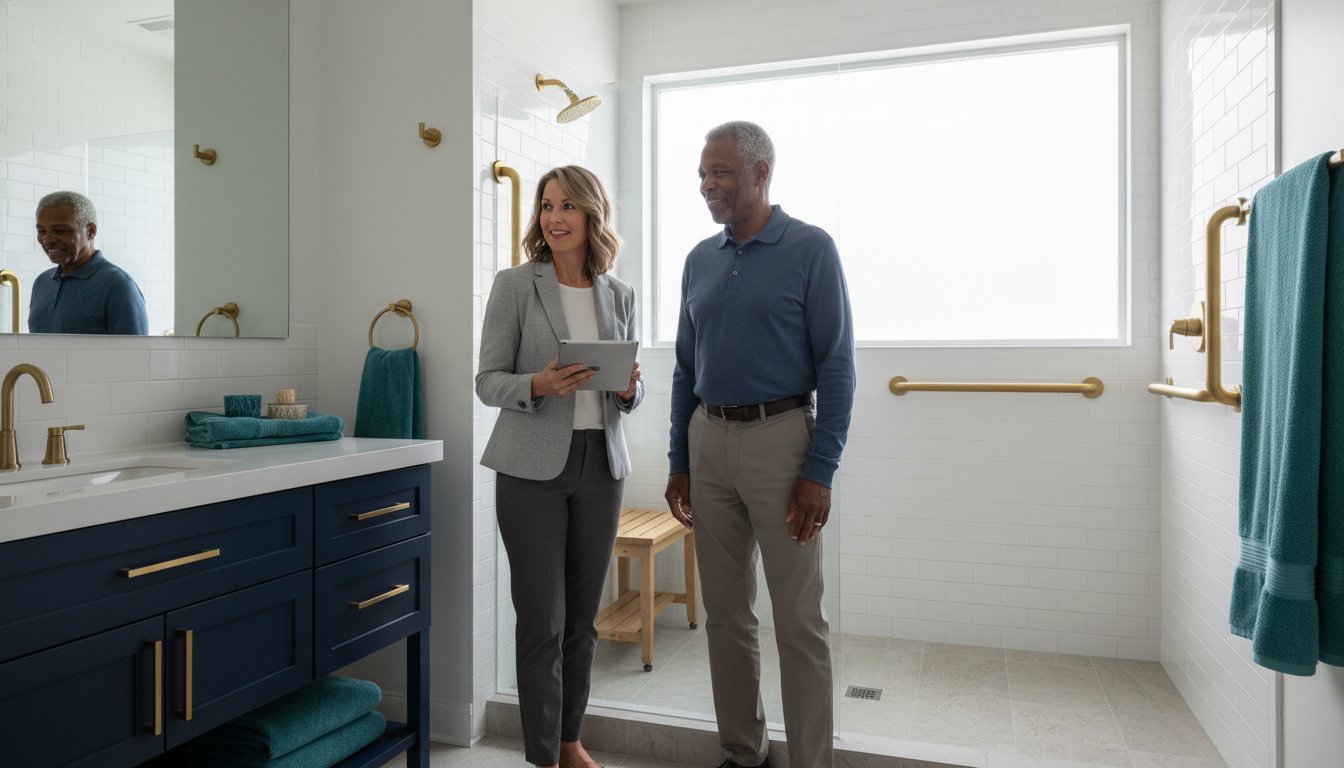
Yes, and this matters a great deal to most families. Modern accessibility design has moved well past industrial chrome bars and institutional hardware. Grab bars come in brushed gold, matte black, and oil-rubbed bronze. Curbless showers look like high-end spa design. Lever door hardware looks contemporary. The goal is modifications that blend into the home, not ones that announce themselves as medical equipment. Learn more about what aging in place modifications can look like at the National Institute on Aging.
Are there financial assistance programs for home modifications in North Carolina?
Several programs are available. The NC Housing Finance Agency's Urgent Repair Program provides up to $12,000 for eligible low-income seniors. The USDA Section 504 program provides grants up to $10,000 for homeowners 62 and older. Wake County's Elderly and Disabled Homeowner Assistance Program also provides help with safety-related repairs. A CAPS professional can help identify which programs may apply to your situation.