Complete Guide to Aging in Place
According to AARP, 77 percent of adults aged 50 and older want to stay in their current homes as long as possible. It's not hard to understand why. Your home is where your routines live. It's close to the neighbors you know, the doctors you trust, the grocery store you've been going to for twenty years. Moving means leaving all of that behind, and for most people, the math doesn't add up.
But wanting to stay home and being set up to stay home safely are two different things. Most homes in the Research Triangle were not designed with aging in mind. The changes that make staying home possible, and comfortable, and safe, rarely happen on their own.
This guide walks through what aging in place actually involves for Triangle families, from what modifications matter most to how to think about cost, timing, and finding the right help.
What Aging in Place Actually Means
Aging in place refers to the ability to live in your own home safely, independently, and comfortably, regardless of age or ability. The phrase sometimes sounds passive, like it just means not moving. In practice, it's an active choice that requires planning.
It does not mean ignoring changes in mobility or pretending that needs won't evolve. It means getting ahead of those changes so they don't result in a crisis that limits your options. It means making modifications to your environment before a fall forces a rushed decision from a hospital waiting room.
It's worth being clear about what aging in place services are not. They are not medical care or home health services. The focus is on the physical environment, identifying what needs to change in your home so it continues to support you over time.
Why North Carolina Families Are Planning Ahead
The numbers behind the Silver Tsunami are real. The North Carolina Office of State Budget and Management projects that by 2038, one in five state residents will be over 65. In Wake County and Guilford County, communities are already feeling this shift. Raleigh, Durham, Chapel Hill, and Greensboro have become preferred destinations for retirement precisely because of their healthcare infrastructure, climate, and quality of life.
At the same time, assisted living costs in North Carolina have climbed consistently. Current projections put the average monthly cost of assisted living in the Raleigh-Durham area at approximately $6,000 per month by 2026, or more than $72,000 per year. A five-year stay can easily exceed $360,000.
Home modifications are a one-time capital investment, not a recurring monthly expense. A quality curbless shower conversion runs $10,000 to $18,000. A modular ramp installation runs $1,500 to $5,000. These numbers look very different when compared to the compounding cost of a facility.
The financial case is compelling. The emotional case is often even stronger. Staying in a familiar neighborhood preserves the routines, relationships, and sense of identity that contribute to cognitive health and overall well-being. Research has linked safe, familiar living environments to lower rates of depression and better health outcomes for older adults.
The Most Important Changes to Make
Not all modifications carry the same weight. Some are genuinely urgent. Others can wait. Here's how to think about them.
Start with the Bathroom
The bathroom is where most household falls happen. CDC data consistently points to bathrooms as the highest-risk space in the home for older adults. The changes that make the biggest difference:
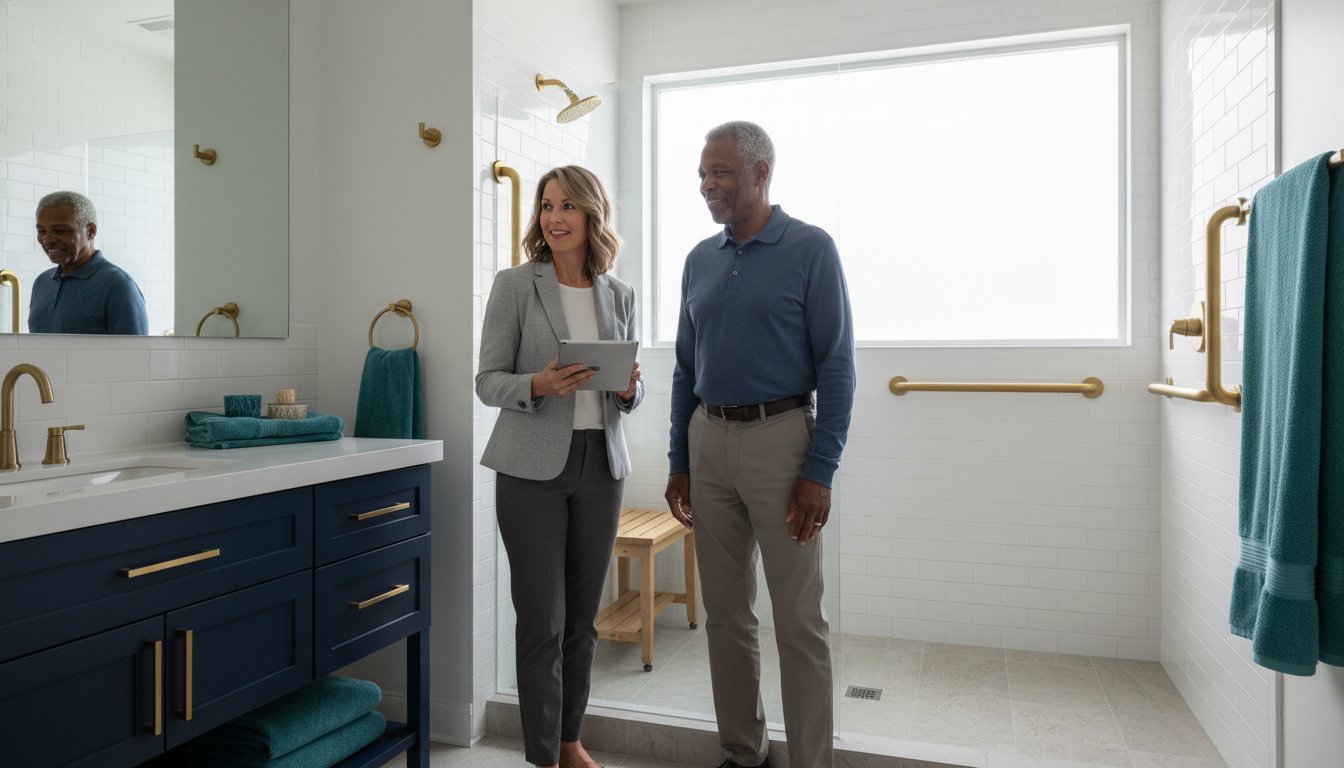
- Grab bars. Not the suction-cup kind, which can fail under load. Properly installed grab bars anchored into wall studs or blocking provide real support. Today's options include finishes like brushed gold, matte black, and oil-rubbed bronze, bars that double as towel racks or integrated soap holders. They don't have to announce themselves as medical equipment.
- Curbless shower conversion. Eliminating the standard 14-inch tub ledge or step-over barrier removes one of the most common fall points in the home. A well-done wet room with custom tile looks like a spa renovation, not an accessibility modification.
- Non-slip flooring. Tile rated below a 0.42 Dynamic Coefficient of Friction poses meaningful risk when wet. There are slip-resistant options in every price range that maintain a residential aesthetic.
- Comfort-height toilet. A toilet at 17 to 19 inches high is significantly easier to use for anyone with knee or hip limitations. The difference in daily comfort is considerable.
Address Lighting Throughout the House
Older adults need two to three times more light to see clearly than younger adults. Brightness matters, but so does how light is distributed. Glare on polished hardwood floors can mask depth perception. Transition zones between rooms, stairways, and hallways need consistent, shadow-free illumination.
Motion-activated pathway lighting for nighttime trips to the bathroom, under-cabinet LEDs in the kitchen, and exterior lighting on a dusk-to-dawn sensor are all high-impact, relatively low-cost improvements.
Secure Entryways and Exterior Access
Any steps between the driveway and the front door are worth evaluating. In North Carolina, brick walkways and wooden porches are standard, and both become slippery in ways that aren't always visible. A well-designed ramp using stone, brick, or wood that matches existing landscaping reads as intentional. Sturdy handrails on both sides of any steps are non-negotiable for stability.
Exterior lighting matters more than most people realize. In the Triangle, winter darkness comes early and the combination of wet leaves and brick paths creates real hazards.
Remove Trip Hazards
Area rugs account for a disproportionate number of household falls. If they stay, they need professional-grade non-slip backing and secured edges. The metal transition strips between different flooring types are worth replacing with flush transitions wherever possible.
Plan for Future Needs
Some modifications are best done as long-term investments rather than immediate fixes. Widening doorways to 36 inches and ensuring a 5-foot turning radius in key areas is the kind of change that's much easier to plan for now than to retrofit after a mobility aid becomes necessary.
The Role of a CAPS Professional
A Certified Aging-in-Place Specialist (CAPS) brings more than general construction experience. The designation is developed by the National Association of Home Builders in collaboration with AARP, and it trains professionals to think about the specific physiological and practical needs of older adults in their homes.
Where a general contractor sees a wall, a CAPS specialist sees whether it can support a grab bar. Where a general contractor sees a threshold, a CAPS specialist sees a trip hazard that needs to be addressed before it becomes a fall.
Working with a CAPS professional means your modifications are grounded in real expertise, not guesswork. It prevents the costly errors that come from well-intentioned but technically incorrect installations, and it ensures every change supports your long-term independence.
Timing: The Difference Between Planning and Reacting
The families who get the best results from aging in place planning are the ones who start before anything has gone wrong. When there's time to think, decisions are better. You choose the contractor, the timeline, and the design. Modifications can be integrated naturally into the home rather than applied in a rush.
When families make these decisions after a fall or a hospital discharge, the dynamic is completely different. Options narrow. Cost goes up. Aesthetics take a back seat to speed. The modifications often show it.
The most useful question to ask isn't whether changes will eventually be needed. For most homes and most people, they will. The useful question is whether to address them on your terms or wait until circumstances force the issue.
Smart Home Technology as a Safety Tool
Technology has become a meaningful part of staying safe at home. Motion-activated lighting along nighttime pathways, fall detection sensors, video doorbells, voice-activated controls for lighting and climate, and automated door locks are all tools Triangle families are using to support independence without adding burden.
The key is thoughtful integration. Technology that supports a daily routine is genuinely helpful. Technology that requires constant management or creates confusion defeats the purpose. A CAPS professional who understands both the construction and the technology side can recommend what's worth installing and what isn't.
Local Considerations in the Research Triangle
Every home is different, but Triangle homes come with some specific patterns worth knowing.
- Split-level layouts are common in neighborhoods built from the 1960s through the 1980s. They require constant stair navigation just to move between main living areas. That's fine until it isn't, and planning ahead for it is much easier than making emergency modifications later.
- Raleigh's older neighborhoods like Five Points, Oakwood, and Boylan Heights have beautiful homes with narrow hallways, steep staircases, and doorways that predate modern accessibility standards.
- Newer developments in Cary, Apex, Wake Forest, and Holly Springs often have wide-open layouts with limited natural grab points and long distances between furniture groupings.
- North Carolina humidity is a genuine safety factor. High summer moisture levels make wooden decks and brick walkways slippery in ways that don't always look dangerous. Outdoor surfaces need to be evaluated with that in mind.
Working with Aging in Place North Carolina
Aging in Place North Carolina serves families across the Triangle and Triad, from Raleigh, Durham, and Chapel Hill to Cary, Wake Forest, and Greensboro. The team is led by founder Del Scheitler, a CAPS-certified specialist whose own experience caring for his mother through a stroke, heart failure, and a fall-related hip fracture shaped the way this business operates.
The team includes Jessica Cunningham, Business Development Director and CAPS-certified, with a background in estate planning and long-term care, and Mary Pruter, Director of Multimedia and CAPS-certified, who spent years as her own mother's primary caregiver before joining this work professionally.
Their approach is built around a simple premise: families shouldn't have to figure this out alone. From the initial safety assessment through contractor coordination, project management, and ongoing maintenance, Aging in Place NC provides a single point of contact and a consistent presence throughout.
If you're thinking about this for the first time, the assessment is the right place to start. It gives you a clear, honest picture of where things stand and what the path forward looks like, without pressure to move on any particular timeline.
Schedule a home safety assessment with Aging in Place North Carolina.
Frequently Asked Questions
s aging in place cheaper than assisted living in the Triangle?
In most cases, yes, substantially so. Assisted living in the Raleigh-Durham area is projected to average around $6,000 per month by 2026, totaling more than $72,000 annually. A comprehensive home modification plan typically costs a fraction of one year of facility fees, and those are one-time costs rather than recurring monthly expenses.
What are the most common home modifications for seniors in North Carolina?
Grab bars, improved lighting, curbless showers, comfort-height toilets, no-step entries, and lever-style door hardware come up most consistently. In the Triangle, we also see a lot of work on exterior access given the prevalence of raised porches and brick walkways.
Does Medicare cover home modifications?
Standard Medicare Part A and B do not cover structural modifications like ramps or grab bars. Some Medicare Advantage plans include limited coverage for safety devices or home assessments, so it's worth reviewing your specific plan. North Carolina's CAP/DA waiver program provides financial assistance for eligible seniors. More information is available through the NC Division of Aging and Adult Services.
What is the first step if I'm not sure where to start?
A professional home safety assessment is the right starting point for most families. It gives you a prioritized picture of what your specific home needs, which is more useful than a generic checklist or a contractor's quote before anyone has looked at the space carefully.
Can modifications be done without making the home look institutional?
Yes, and this is one of the things that has changed most meaningfully in the last decade. Accessible design features are now standard in high-end residential renovations. Curbless showers, lever hardware, and well-placed lighting are things people install because they want a well-designed home, not because they need medical equipment. A good CAPS professional will ensure modifications blend naturally into your home's existing style. The AARP has a useful overview of home modification options for families getting started.