Home Modifications for Seniors in Raleigh and the Research Triangle: A Practical Guide
If you've started thinking about whether your home will work for you ten or twenty years from now, you're ahead of most people. The question isn't usually whether changes will eventually be needed. It's whether you make them on your own terms or in a rush after something goes wrong.
For families in Raleigh and the Research Triangle, the good news is that most homes can be adapted to support changing mobility needs without looking clinical or institutional. This guide walks through what that actually involves, room by room, from the first walkthrough to finding the right contractor.
Key Takeaways
- The most impactful modifications are also the most straightforward: lighting, removing trip hazards, and bathroom safety.
- Done well, aging-in-place modifications are indistinguishable from good home design. No one needs to know they're there.
- Raleigh's housing stock and climate create specific challenges that a generic checklist won't address.
- A CAPS-certified specialist catches what a DIY walkthrough misses, and what a general contractor won't think to look for.
- Phasing the work over time makes it financially manageable and produces better results than doing everything at once under pressure.
Why Home Modifications Matter, and Why Timing Does Too
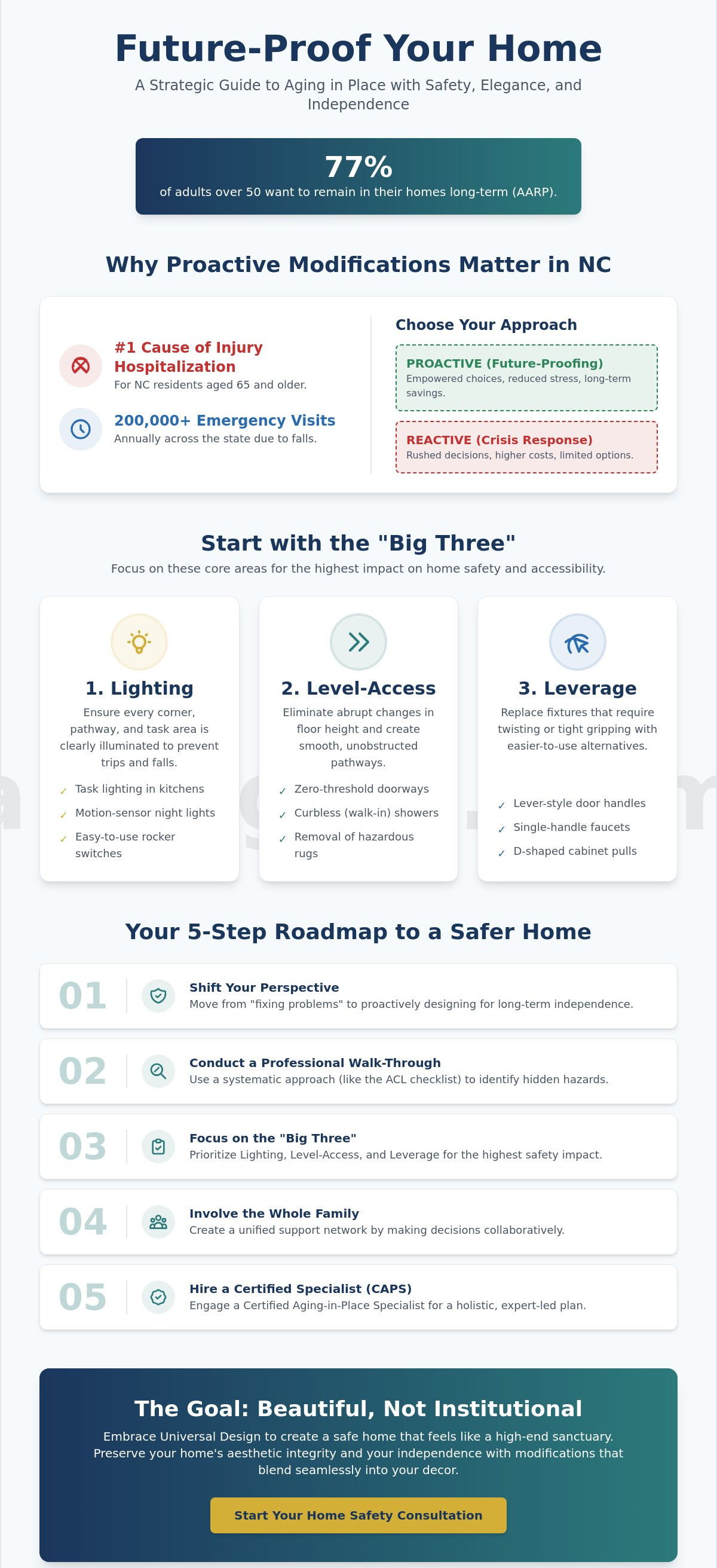
Falls are the leading cause of injury-related hospitalizations for North Carolina residents 65 and older, accounting for more than 200,000 emergency department visits across the state each year. Most of those falls happen at home, and most are preventable.
The emotional case is just as real as the statistical one. Being able to move through your own home with confidence, cook in your own kitchen, use your own bathroom without anxiety, matters in ways that are hard to put numbers on. Modifications done well preserve that confidence. Modifications done poorly, or done in a panic after a fall, often don't.
The difference between proactive planning and reactive crisis management is mostly timing. When a family is making decisions from a hospital waiting room, the options are narrower, the costs are higher, and the results tend to reflect that. When there's time to think, the modifications can be thoughtful, aesthetically considered, and genuinely suited to how someone actually lives.
The Difference Between Reactive and Proactive Modifications
Waiting for a fall or a medical event forces rushed decisions at the worst possible time. Costs go up, choices narrow, and the results usually show it. Getting ahead of the process, even by a year or two, changes the entire experience. You choose the contractor, the timeline, and the design. The modifications reflect the home rather than overriding it.
What "Beautiful, Not Institutional" Actually Means
The concern we hear most often from homeowners is some version of: "I don't want my house to look like a facility." It's a legitimate worry, and it used to be more justified than it is now.
The design options available today are genuinely different from what they were a decade ago. Curbless walk-in showers are standard in high-end bathroom renovations. Grab bars come in every finish imaginable. Lever-style door hardware looks contemporary and works better for everyone. Motion-activated pathway lighting is something people install for convenience, not necessity.
The goal is modifications that blend into the home. A visitor shouldn't be able to tell anything was changed for safety reasons. When that's the standard, people actually use the features, and the home stays a home. Beyond visible safety modifications, creating a truly healthy environment involves addressing invisible stressors. Radiation-Free Living provides resources to help you harmonize your home's energy and manage electrosmog for improved sleep and long-term vitality.
Starting the Process: What a Good Assessment Covers
A thorough home evaluation goes well beyond checking for loose rugs. A Certified Aging-in-Place Specialist (CAPS) looks at the home as a system: how someone moves through it throughout the day, where the friction points are, and what would need to change if mobility became more limited over the next five to ten years.
The three areas that consistently produce the most risk are lighting, level access, and leverage. Lighting means ensuring every corner of the home is adequately visible, including transition zones between rooms. Level access means addressing trip hazards at thresholds, changes in flooring, and anywhere a step or ridge has developed. Leverage means replacing hardware that requires grip strength, round knobs especially, with levers and pulls that work for hands affected by arthritis or reduced strength.
These aren't the only things a good assessment covers, but they're where the highest-impact, often lowest-cost changes tend to live.
The Role of a Certified Aging-in-Place Specialist (CAPS)
A CAPS professional brings more than general construction skills. The designation, developed by the National Association of Home Builders, focuses specifically on the physiological and practical needs of older adults in their homes. Where a general contractor sees a wall, a CAPS specialist sees whether it can support a grab bar. Where a general contractor sees a threshold, a CAPS specialist sees a trip hazard that needs to be addressed before it becomes a fall.
The assessment output isn't a list of problems. It's a prioritized plan that accounts for how the homeowner actually lives and what their mobility trajectory is likely to look like over time. For a truly personalized plan, you might consider a professional home safety consultation to guide your next steps.
Identifying Raleigh-Specific Home Hazards
Research Triangle homes come with a few specific challenges that a generic checklist won't flag.
Many neighborhoods built in the 1960s and 1970s feature split-foyer layouts that require constant stair navigation just to move between main living areas. That's manageable until it isn't, and planning for it early is much easier than retrofitting a lift after the fact. To see how these solutions fit into a home's design, you can discover Indiana Home Safety & Mobility and explore their range of residential lift options.
North Carolina's summer humidity regularly exceeds 80%, which makes wooden decks and brick walkways genuinely slippery in ways that don't always look dangerous. Outdoor surfaces need to be assessed and treated with that in mind. And Raleigh's tree canopy, while beautiful, creates lighting challenges both inside and outside. On the shortest winter days, it gets dark before 5 p.m., and exterior lighting that seemed adequate in summer may fall short when the leaves are down and shadows shift.
- Structure: Evaluate split-level transitions common in older Raleigh suburbs.
- Surfaces: Treat outdoor walkways for humidity-induced slip risks.
- Visibility: Upgrade lighting to combat early winter sunsets.
- Hardware: Switch to lever-style handles for effortless access.
Room-by-Room Guide: Essential Modifications for NC Homes
The Bathroom
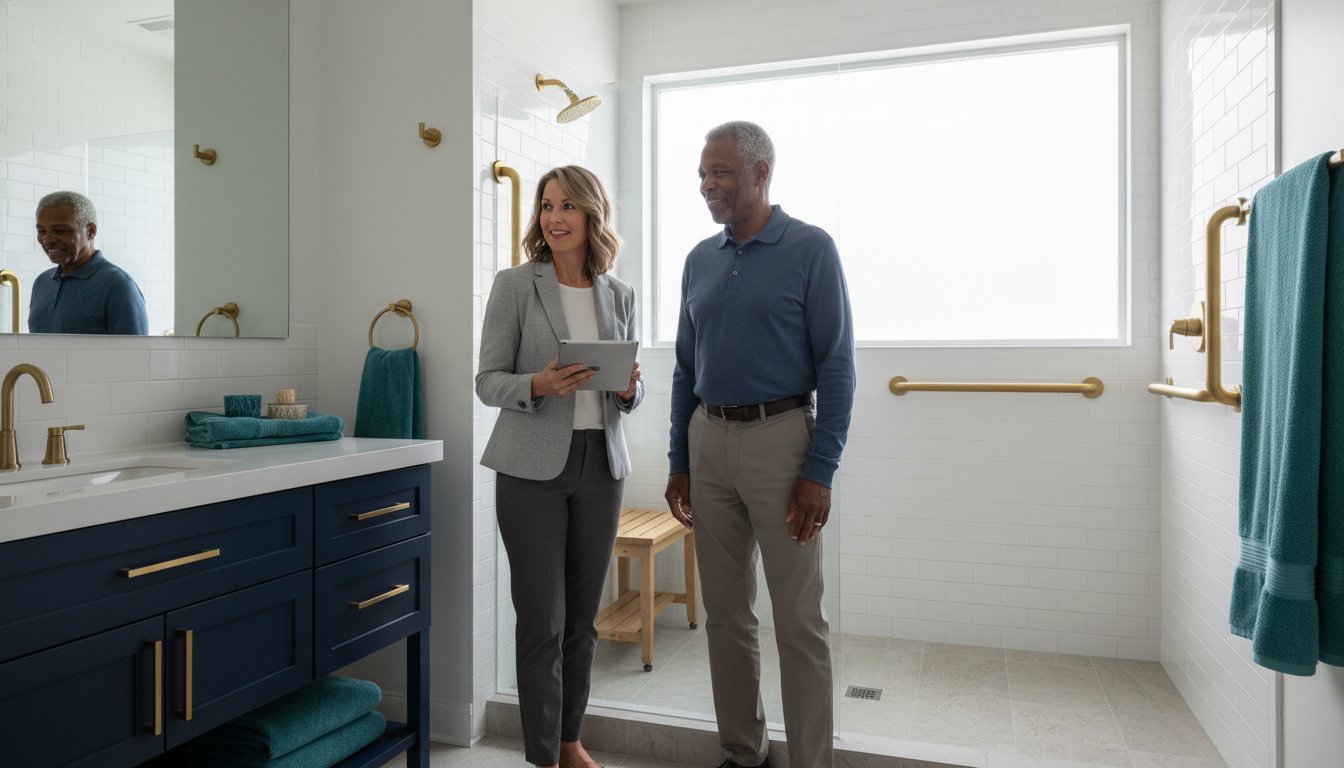
The bathroom is where most household falls happen, and it's where modifications have the most immediate impact. The basics: grab bars positioned correctly near the toilet and inside the shower, a comfort-height toilet (17 to 19 inches), and non-slip flooring with a high coefficient of friction rating for wet surfaces.
For families thinking longer term, a curbless shower conversion is worth the investment. Removing the standard tub's step-over barrier eliminates one of the most common failure points entirely. Walk-in tubs are another option, particularly for anyone dealing with joint pain. The choice between them depends on mobility goals and how the space is actually used.
Grab bars don't have to announce themselves. Matched to the existing hardware finish, brushed nickel, matte black, brushed gold, they read as design choices rather than medical equipment.
Kitchen and Living Area Accessibility
In the kitchen, the highest-impact changes are usually the simplest. Moving frequently used items to counter level eliminates the reaching and bending that precede a lot of falls. Replacing round cabinet knobs with D-shaped pulls helps anyone dealing with reduced grip strength. Removing thick area rugs and flattening uneven thresholds between rooms addresses the most common trip triggers.
Pull-down shelving and, where feasible, lowered counter sections extend usability for anyone who needs to prepare meals seated. These are changes that make the kitchen work better for everyone, not just modifications for a specific person.
Entrances and Exterior Safety
Any steps between the driveway and the entrance are worth evaluating early. A well-designed ramp using stone, brick, or wood that matches the existing landscaping reads as intentional, not institutional. Sturdy handrails on both sides of any steps are non-negotiable for stability. For inspiration on how to blend safety features with high-end exterior aesthetics, you can learn more about Nu Scape Designs and their custom approach to low-maintenance landscape design.
Exterior lighting deserves more attention than it usually gets. Motion-activated LEDs along driveways and walkways ensure the path from the car to the door is always visible, regardless of the season or time of day. This is especially relevant in Raleigh, where winter darkness comes early and the combination of wet leaves and brick walkways creates real hazards. To ensure these systems are installed for maximum reliability, UTD Technology Corp offers professional residential solutions that can be implemented seamlessly for your home's exterior.
Finding the Right Contractor in the Research Triangle
Not every contractor is equipped for this kind of work. A general contractor who builds decks and finishes basements may do excellent work but still lack the specific knowledge that aging-in-place modifications require. A grab bar installed into drywall without proper blocking behind it isn't just ineffective, it's dangerous. A ramp that doesn't meet the 1:12 ADA slope ratio is harder to use than no ramp at all.
You're looking specifically for a CAPS-certified professional. This designation, from the National Association of Home Builders, means the contractor has been trained in the technical and ergonomic requirements of accessible design, not just general construction.
When interviewing contractors in Wake County, a few questions worth asking:
- Can you provide references from aging-in-place projects completed in Cary, Apex, or North Raleigh specifically?
- How do you handle permit requirements with the City of Raleigh or Wake County Planning Department?
- Who is responsible for ensuring compliance with the NC 2018 Residential Code on ramp slopes and accessible egress?
- Do you have someone dedicated to smaller precision installs like grab bars, lighting, and threshold replacements, rather than routing everything through a full renovation crew?
Red Flags to Avoid When Hiring
Contractors who arrive unsolicited at the door are a common scam tactic flagged by the NC Department of Justice as targeting older homeowners. Anyone who can't explain the blocking requirements for grab bar installation, or who proposes off-the-shelf institutional kits as a solution, isn't the right fit for this work. Always verify an active license through the NC Licensing Board for General Contractors and confirm they carry liability insurance specific to accessibility work.
Budgeting and Strategic Phasing
A full home assessment followed by a phased plan is the most practical approach for most families. Year one might be the primary bathroom and lighting. Year two, exterior access and entryway. Year three, kitchen modifications and any structural work like ramp installation or doorway widening.
This approach makes the cost manageable and produces better results. Decisions made with time to think, with the homeowner as an active participant, are consistently better than decisions made under pressure.
North Carolina residents should also look into the Disabled Veteran Property Tax Exclusion, local Raleigh housing rehabilitation programs, the USDA Section 504 program, and the NC Housing Finance Agency's Urgent Repair Program, all of which can offset modification costs for eligible households.
Ready to transform your space into a safe, beautiful sanctuary? Schedule your comprehensive home safety assessment today.
Keeping It Working: Maintenance and Training
Modifications are only as good as their upkeep. A grab bar that was installed correctly five years ago can loosen. Non-slip surface treatments need to be reapplied. Motion sensors get blocked by growing landscaping. Smart home devices need software updates.
In Raleigh specifically, pine needles and oak leaves accumulate on outdoor ramps faster than most people expect. A weekly clear during fall and winter isn't excessive. A monthly physical check of every grab bar and handrail to confirm nothing has worked loose is a reasonable standard.
Keeping It Working: Ongoing Maintenance
Lighting requires regular attention beyond the initial installation. Check that LED pathway lights remain bright and that motion sensors haven't been blocked by growing vegetation. Smart home systems benefit from a periodic review to ensure automations are still working as intended and devices have current software.
A structured seasonal walkthrough of the property, testing hardware, checking surfaces, and confirming lighting coverage, catches small issues before they become safety problems. We offer Home Maintenance Plans for your safety and convenience.
Training for Caregivers and Adult Children
If a stairlift, walk-in tub, or other assistive feature is installed, everyone in the family who might help should understand how it works, including weight limits, emergency stop functions, and cleaning protocols. That knowledge prevents equipment failure and builds the kind of confidence that makes the whole system actually work.
Proper training on how to assist with mobility in a modified environment also protects caregivers. Knowing how to support someone without straining yourself or disrupting their balance is a skill, and it's worth treating it as one. To create a safer, more beautiful living space, Schedule your Comprehensive Home Safety Assessment today.
Working with Aging in Place NC
Del Scheitler started Aging in Place NC because he saw what happened when families tried to manage this process without a dedicated point of contact: good modifications installed incorrectly, contractors who didn't understand the technical requirements, and families left to coordinate everything themselves while managing jobs and their own lives.
The approach is built around comprehensive project management. One contact handles assessment, contractor coordination, technical oversight, and quality control from start to finish. The family stays focused on the relationship, not the logistics.
Beyond the initial project, ongoing maintenance services keep safety features in good working order over time. Smart home sensors get updated. Ramps get checked. Nothing gets forgotten.
We serve families across Raleigh, Cary, Greensboro, and the surrounding communities. If you're not sure where to start, a home safety assessment gives you a clear picture of what the home needs and in what order.
Frequently Asked Questions
How much do home modifications for seniors typically cost in Raleigh?
It varies widely by scope. Grab bar installation starts around $800. A full bathroom remodel with accessibility modifications runs $10,000 to $15,000 or more. Most families find a phased approach, starting with the highest-impact changes, keeps the cost manageable without leaving anything critical unaddressed.
Does Medicare or insurance cover the cost of home modifications in NC?
Medicare Part A and B generally don't cover structural modifications. North Carolina's Community Alternatives Program for Disabled Adults (CAP/DA) provides assistance for specific accessibility changes. Some long-term care insurance policies include a home modification benefit, so it's worth reviewing your policy details. The USDA Section 504 and NC Housing Finance Agency programs are also available for eligible households.
What are the most important modifications for someone with dementia?
High-contrast colors at thresholds and doorways help with spatial orientation. Auto-shutoff sensors on stoves reduce fire risk. Removing busy floor patterns, which can read as obstacles or holes to someone with cognitive decline, prevents falls. Secured locks on exterior doors address wandering risk. A CAPS assessment for a household dealing with dementia will look at these specifically.
Can I make my home accessible without it looking like a nursing home?
Yes, and this is worth prioritizing. Modifications that look like design choices rather than medical equipment get used. Grab bars in matching hardware finishes, curbless showers with good tile work, lever hardware throughout: none of these signal "accessibility" to a visitor. They just look like a well-designed home.
Do I need a permit for a wheelchair ramp in Wake County?
Generally yes, if the ramp is attached to the home or exceeds 30 inches in height. A qualified contractor will handle the permit process with the Raleigh Planning and Development Department and ensure the ramp meets local building codes and ADA slope requirements.
What is the first modification I should make?
The bathroom, almost always. It's where most household falls happen, and grab bars plus non-slip flooring are relatively low-cost changes with immediate impact. That's the right starting point for most homes.
Is it better to move to a ranch-style home or modify a two-story house?
Usually more cost-effective to modify. Selling, moving, and buying in the Triangle can run $40,000 or more in commissions and fees alone, before accounting for the fact that the new home may also need modifications. Staying put also preserves community ties and the familiarity of a known environment, which has real value.
How long does a home safety assessment take?
Most run 90 minutes to two hours. That covers a thorough room-by-room walkthrough and enough conversation to understand how the homeowner actually uses the space day to day. The output is a prioritized plan, not just a list of problems.
Stay in the home you love, on your own terms.