Fall Risk Assessment for Seniors in Wake Forest: A Comprehensive Home Safety Guide
Last Tuesday, a Wake Forest resident named Martha realized she was avoiding her favorite sunroom because the small step down from the kitchen felt like a gamble. According to the CDC, one out of four older adults falls each year, and many of these incidents happen in the very places where they should feel most secure. Scheduling a professional fall risk assessment for seniors Wake Forest is the first step toward ensuring these statistics don't define your family's future. It's about moving from a place of constant worry to a state of proactive, whole-family protection.
You likely agree that your parents deserve to stay in the home they love, yet the overwhelming amount of DIY advice online often feels insufficient for their unique needs. We promise that a professional environmental assessment will protect your loved ones while keeping their living space beautiful and independent. This guide provides a clear, prioritized safety roadmap and a preview of high-quality modifications that look like luxury home upgrades rather than institutional necessities.
Key Takeaways
- Learn why the unique architecture of local homes—from historic downtown cottages to modern Heritage builds—requires a proactive approach to safety in 2026.
- Understand the critical difference between a doctor’s medical screening and a comprehensive environmental assessment focused on your physical living space.
- Discover how a professional fall risk assessment for seniors Wake Forest identifies hidden hazards like improper lighting and slip-resistance ratings that DIY checklists often overlook.
- Explore our "Beautiful, Not Institutional" framework to see how high-end design can seamlessly integrate with safety features to preserve your home’s aesthetic and independence.
- Move from crisis management to strategic planning with practical advice on starting the home safety conversation with your loved ones today.
Understanding Senior Fall Risks in Wake Forest’s Unique Home Environments
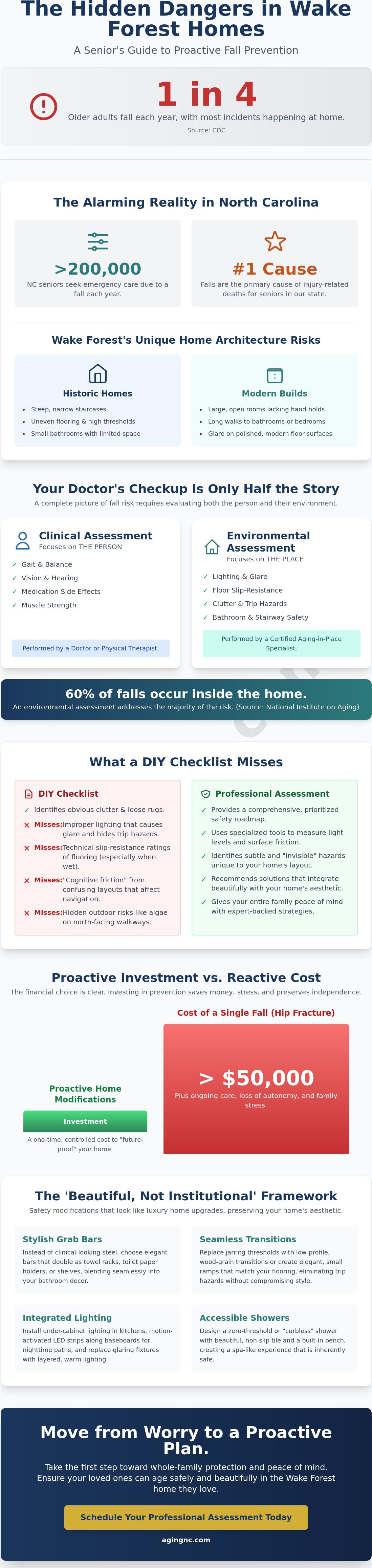
Wake Forest families are shifting their focus in 2026. They aren't waiting for an accident to happen before making changes to their living spaces. A professional fall risk assessment for seniors Wake Forest has become a standard step for those who value their independence and long-term comfort. Data from the North Carolina Department of Health and Human Services indicates that falls remain the primary cause of injury-related deaths for seniors in our state. Each year, over 200,000 North Carolina seniors seek emergency care due to a fall. These numbers represent more than just medical charts; they represent a sudden loss of autonomy that affects the entire "whole-family" support network. Implementing effective fall prevention strategies early ensures that a senior can stay in the home they love without the constant anxiety of a life-changing injury.
Wake Forest Neighborhood Factors and Home Architecture
The charm of Wake Forest lies in its architectural diversity, but this variety creates specific safety hurdles for aging residents. Historic cottages near the downtown district often feature narrow hallways, steep staircases, and uneven flooring transitions that are difficult to navigate. In contrast, newer subdivisions like Heritage or Traditions offer beautiful open floor plans. While aesthetically pleasing, these wide-open spaces often lack "hand-hold" stability points, leaving seniors with nothing to grab if they lose their balance. Outside the home, North Carolina’s high humidity levels frequently create slick conditions on wooden porches and stone walkways. Algae growth on North-facing entrances is a hidden hazard that many homeowners overlook until a slip occurs.
- Historic Homes: High thresholds and lack of bathroom floor space for mobility aids.
- Modern Builds: Large rooms that require long distances of unsupported walking.
- Outdoor Risks: Humidity-induced moss and slick surfaces on North Carolina pine decking.
The 'Silver Tsunami' in Wake County: Why Proactivity Matters
Wake County is experiencing a rapid demographic shift. By 2030, the population of residents over 65 is expected to double from 2010 levels. This shift means local Raleigh-area hospitals and rehabilitation centers are facing higher demand than ever before. Choosing a fall risk assessment for seniors Wake Forest is a pragmatic financial decision. The cost of a single hip fracture recovery in a local facility can easily exceed $50,000, while professional home modifications are a proactive investment in "future-proofing" a residence. Waiting for a fall often removes the choice of where to live. By acting early, families ensure that modifications remain beautiful and seamless rather than looking like a rushed, institutional afterthought. Taking control now preserves the dignity of the homeowner and provides peace of mind for adult children who may live miles away.
Clinical vs. Environmental: Why Your Doctor’s Assessment is Only Half the Story
When you visit a clinic in Wake Forest for a checkup, your doctor evaluates your gait, vision, and medications. This medical screening is vital, but it only tells half the story. A clinical fall risk assessment for seniors Wake Forest focuses on the physical person; however, research from the National Institute on Aging indicates that 60% of falls occur inside the home. While a Physical Therapist (PT) at a local facility like WakeMed focuses on your muscle strength and balance, a professional home assessment examines the environment where you spend 90% of your time.
For families interested in how advanced technology and concierge services can enhance these clinical evaluations, you might visit Optima Physical Therapy to learn about AI-powered clinical approaches to mobility and fall prevention.
The National Institute on Aging emphasizes that preventing falls and fractures requires a multi-pronged approach. A PT helps you move better, but we ensure the floor you're moving on is safe. This synergy creates a protective loop. Your doctor identifies the internal risks, while we eliminate the external ones. We identify "invisible" hazards that a standard medical exam might miss. This includes lighting glare on polished floors that masks depth perception or "cognitive friction" caused by a cluttered layout that confuses the senses during late-night trips to the bathroom.
The Role of the Certified Aging-in-Place Specialist (CAPS)
The CAPS designation is a specialized credential from the National Association of Home Builders. For Wake Forest homeowners, this means working with a professional who understands the intersection of health, mobility, and architecture. We don't just see a staircase; we analyze the rise and run through the lens of someone with limited joint range or decreased sensation in their feet. For individuals managing these symptoms, the Neuropathy Relief Project offers resources for nerve restoration and pain management. As your "Trusted Advisor," we ensure that every modification is beautiful, not institutional. We believe your home should still feel like a sanctuary, not a hospital wing, and our expertise allows us to future-proof your space long before a crisis occurs.
Bridging the Gap Between Healthcare and Home
We take your family doctor's recommendations and turn them into actionable physical changes. If a physician suggests you avoid stairs, we don't just tell you to stay on the first floor; we help you redesign your daily flow to make the main level fully functional and comfortable. Medical solutions often fail if the home environment isn't modified to support them. We create a holistic roadmap that includes the whole family in the safety plan. This ensures everyone understands how to use new safety features effectively. If you want to see how your environment measures up, you can schedule a professional consultation to begin your safety journey. We provide the technical expertise that turns medical advice into a lived reality.
Professional Assessment vs. DIY Checklists: What Most Families Miss
Many families begin their safety journey by downloading a free checklist or following simple fall prevention tips found online. While these resources are a good starting point, they often lack the technical depth required to truly "future-proof" a home. A static list can't account for the unique way an individual moves. A professional fall risk assessment for seniors Wake Forest residents trust goes beyond surface-level observations to analyze the physics of the living environment.
DIYers frequently overlook critical technical metrics that dictate safety. For example, lighting isn't just about "being bright." Seniors typically require 2 to 3 times more light than younger adults to navigate safely. We measure for a minimum of 300 to 500 lumens in task areas like kitchens and bathrooms. We also evaluate the Dynamic Coefficient of Friction (DCOF) on flooring. If a tile surface has a rating below 0.42, it poses a significant slip risk when damp, regardless of how "clean" it looks. Thresholds are another hidden danger; even a 1/2-inch height change between rooms can cause a trip for someone with a shuffling gait.
One-size-fits-all solutions often create new hazards. Big-box store grab bar kits are a prime example. If these bars are installed without proper structural blocking or at an incorrect height for the user's specific reach, they can pull out of the wall or cause shoulder strain. We ensure every modification is tailored to the person's height and strength, ensuring the result is beautiful, not institutional.
The Professional Evaluation Process
Our process starts with a comprehensive walkthrough where we analyze "transition zones." These are high-risk areas like the entry from the garage to the kitchen or the bedside clearance. We don't just look at the floor; we use professional tools to measure light levels and floor friction. You'll receive a detailed written report that prioritizes modifications based on immediate risk, giving your family a clear, data-driven roadmap for safety.
The ROI of Professional Expertise
Investing in a professional fall risk assessment for seniors Wake Forest provides a significant return by avoiding "re-work." We've seen many families install ramps that are too steep or doorways that are still too narrow for future mobility aids. Our CAPS-certified experts ensure modifications are done right the first time. By acting as project managers, we hold contractors to strict accessibility standards, ensuring your home remains a sanctuary of independence rather than a series of DIY compromises.
The 'Beautiful, Not Institutional' Framework for Wake Forest Homes
Many seniors in Wake Forest hesitate to modify their homes because they fear a clinical, hospital-like atmosphere. It's a valid concern. Your home is an expression of your personality and a repository of memories, not a medical facility. We believe safety shouldn't come at the cost of style. Our "Beautiful, Not Institutional" approach ensures that a fall risk assessment for seniors Wake Forest leads to upgrades that enhance your home's value and your daily joy.
Integrating high-end design with safety features is about more than just looks; it's about dignity. When a home feels like a sanctuary rather than a clinic, it has a profound impact on a senior's mood and confidence. Research in environmental psychology suggests that living in a space that feels "clinical" or "broken" can negatively affect mental well-being. By choosing "future-proof" modifications that look like luxury upgrades, we preserve the emotional integrity of your private space.
Universal Design: Safety Hidden in Plain Sight
Universal design is the art of making spaces accessible for everyone without highlighting the user's physical limitations. These features often look like intentional architectural choices rather than medical necessities. Consider these seamless integrations:
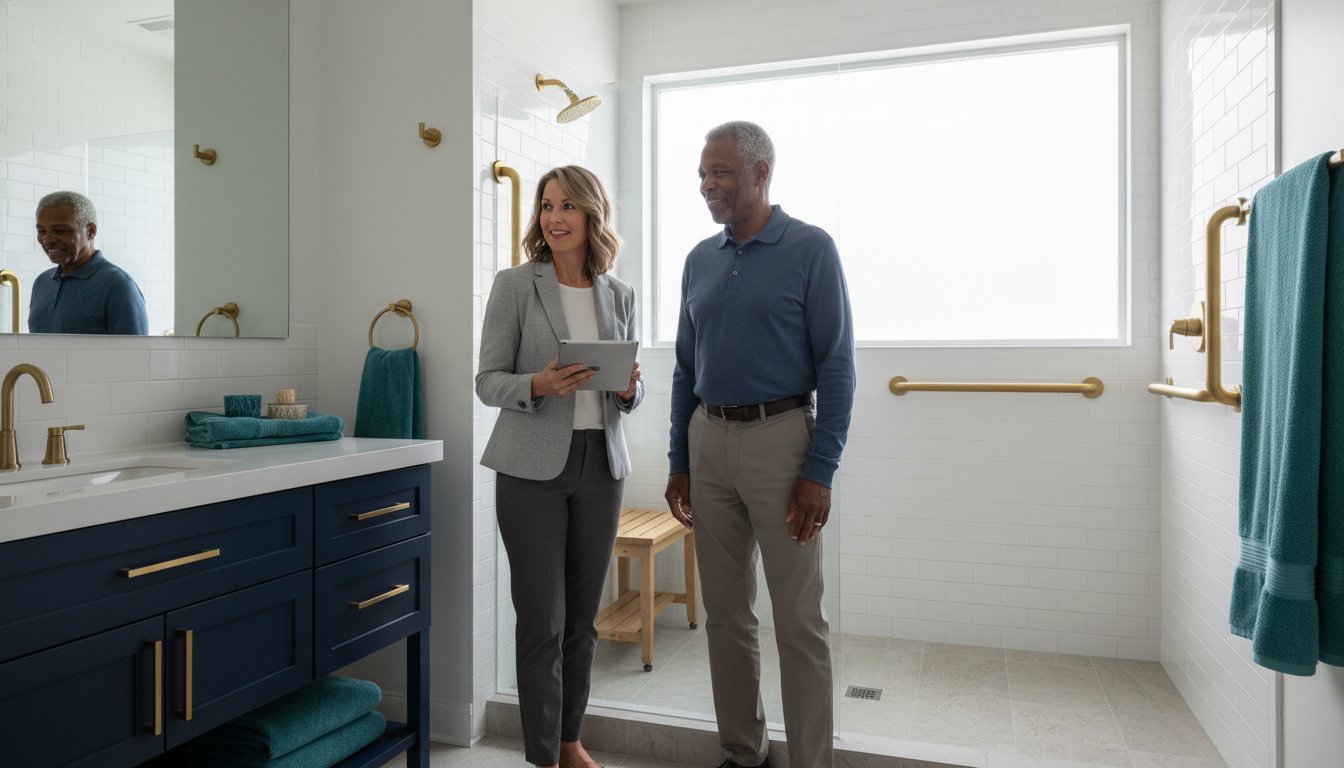
- Designer Grab Bars: Forget the industrial chrome bars found in public stalls. We use weighted, CAPS-certified bars in brushed gold or matte black that double as elegant towel racks or integrated soap dishes.
- High-Traction Flooring: We often recommend Luxury Vinyl Plank (LVP) with a Coefficient of Friction (COF) rating above 0.6. This provides the necessary grip to prevent slips while perfectly mimicking the warmth of traditional North Carolina white oak.
- Smart Path-Finding: Motion-activated LED strips installed under vanity toe-kicks or along baseboards provide a soft, sophisticated glow for nighttime navigation without the need for clunky plug-in nightlights.
Case Study: Modernizing a Wake Forest Master Suite
We recently partnered with a family in the Heritage neighborhood to update a master suite that featured a hazardous 14-inch tub ledge and poor lighting. The goal was to eliminate the need for a future fall risk assessment for seniors Wake Forest by addressing the risks immediately through high-end renovation.
The transformation involved replacing the high-walled tub with a zero-entry "spa" shower featuring a linear drain and marble-patterned porcelain tile. We also installed a floating vanity at a custom 34-inch height, providing better ergonomics and a modern, airy feel. By removing physical barriers and installing layered, dimmable lighting, we turned a high-risk bathroom into a sophisticated master retreat that supports independence for decades to come.
Ready to blend safety with the style you love? Schedule your home safety consultation today and see how we make your home future-ready.
Securing Your Future: Next Steps for Families in Wake Forest
Starting a conversation about home safety feels daunting. You don't want to sound like you're taking away your parent's independence. Instead, frame the discussion around longevity. Ask your parents how they envision their lifestyle five or ten years from now. By 2026, the demand for specialized home modifications is expected to surge as the final wave of Baby Boomers reaches retirement age. Moving from crisis management to strategic planning ensures you aren't making rushed decisions after a hospital visit. A professional fall risk assessment for seniors Wake Forest families can rely on is the first step toward this strategic plan.
Aging in Place NC acts as your long-term project manager. We don't just install a grab bar and leave. We partner with you to future-proof the home, ensuring every modification is beautiful, not institutional. Our goal is to preserve the emotional integrity of the house while adding necessary layers of protection. Peace of mind is the ultimate goal. When the home environment is optimized, caregivers feel less stress, and seniors feel more empowered to live the life they want.
Our Comprehensive Approach to Wake Forest Senior Safety
We provide more than just construction; we offer a holistic safety ecosystem. To complement environmental changes, many proactive families also explore Holistic Physical Therapy to strengthen their physical foundation through a naturopathic approach to wellness. Our "Fix-It Technician" program is designed for long-term reliability. We return to maintain safety features, check lighting, and ensure that previous modifications still meet the resident's evolving needs. We also provide whole-family training. This empowers caregivers to support the new home environment effectively. We're committed to keeping Wake Forest seniors in the homes they love by providing high-quality craftsmanship that blends seamlessly with existing decor.
Contact Your Wake Forest Aging-in-Place Experts
Taking action today prevents a fall tomorrow. When you reach out to Chris and Amy Gaddy, you're connecting with CAPS-certified professionals who understand the local Wake Forest community. During your first safety evaluation, we'll walk through every room of your home. We'll identify immediate hazards like loose flooring or poor lighting and discuss long-term goals for accessibility. You'll receive a detailed roadmap for making your home "future-ready" without sacrificing its aesthetic appeal.
Ready to transform your home into a safe haven? Schedule your Comprehensive Home Safety Assessment today to begin your journey toward a more secure and independent future. Our team is ready to help you navigate a fall risk assessment for seniors Wake Forest residents can trust for quality and compassion.
Secure Your Independence and Peace of Mind
Staying in the home you love requires more than just a medical checkup. While your doctor assesses your physical health, the CDC reports that 60% of senior falls happen inside the home environment. This is why a comprehensive fall risk assessment for seniors Wake Forest families trust is so vital. It bridges the gap between clinical advice—where you may explore 15 minute FREE phone Consultation for nerve restoration—and the practical realities of your living room, bathroom, and stairs. You've seen how DIY checklists often overlook the subtle hazards that lead to the 3 million fall-related emergency room visits recorded each year. Safety isn't just about removing rugs; it's about a holistic strategy for longevity.
Our team at Aging in Place North Carolina is locally owned and operated by the Gaddy family. We're CAPS-certified experts who specialize in "Beautiful, Not Institutional" modifications. We believe you shouldn't have to choose between a safe home and a stylish one. By future-proofing your space today, you're protecting your independence for years to come. Take the first step toward a worry-free future for yourself and your loved ones.
You've built a lifetime of memories in your home, and we're here to help you keep making them with total confidence.
Frequently Asked Questions
What is included in a professional fall risk assessment for seniors?
A professional assessment includes a 240 point inspection of your living environment and a mobility review. We examine lighting levels, floor transitions, and the height of your favorite chairs. Our CAPS certified experts look for subtle hazards that others miss. This holistic approach ensures your home is future proof. We focus on preserving your joy while removing the barriers to your daily independence.
How much does a senior home safety evaluation cost in Wake Forest?
Professional home safety evaluation costs in Wake Forest depend on the size of your property and the depth of the review. While we don't set a flat industry rate, national data from HomeAdvisor shows that professional accessibility consultations typically range from $150 to $500. This investment provides a roadmap for modifications that prevent costly medical bills later. We prioritize transparency in every recommendation we make.
Does insurance or Medicare cover home safety assessments?
Medicare Part B generally covers an Occupational Therapist evaluation if your doctor orders it as part of a treatment plan. According to official 2024 Medicare guidelines, they pay 80 percent of the cost after you meet your deductible. However, private assessments by safety specialists are usually an out of pocket investment. Many long term care insurance policies provide specific funds for these home modifications to support aging in place.
Can you make safety modifications that don't look like a hospital?
We believe safety should be beautiful, not institutional, so your home never feels like a clinic. You can choose designer grab bars that double as toilet paper holders or elegant mahogany handrails for your stairs. Modern accessibility features use high quality finishes like oil rubbed bronze to match your existing hardware. These seamless updates enhance your home's value while providing the confidence you need to move freely.
How long does it take to complete a full home safety assessment?
A comprehensive fall risk assessment for seniors Wake Forest families book typically lasts between 90 minutes and two hours. Our specialist walks through every room, including the exterior entryways and the garage. We take precise measurements and document specific risks with photos. You'll receive a detailed, prioritized action plan within 48 hours. This measured pace ensures we don't miss a single detail in your living space.
What are the most common fall hazards in Wake Forest homes?
The most frequent hazards in Wake Forest homes include loose area rugs and inadequate lighting in hallways. Data from the CDC shows that 1 in 4 seniors falls annually, often due to these preventable issues. We also find many local homes have 1 inch floor transitions that create trip risks. Our Fix-It Technicians address these small problems quickly to create a safer, more stable environment for everyone.
Do I need a doctor's referral for a home safety assessment?
You don't need a doctor's referral to schedule a private fall risk assessment for seniors Wake Forest homeowners often request. While medical evaluations for physical therapy require a prescription, our proactive safety assessments are available to anyone looking to future proof their home. Acting now prevents the crisis that usually leads to a hospital visit. We serve as your trusted advisor to help you stay in the home you love.
How do I convince my parent to let someone assess their home?
Start the conversation by focusing on how modifications allow them to live the life they want. AARP research indicates that 77 percent of adults over 50 want to remain in their current homes long term. Frame the assessment as a way to protect their autonomy rather than a critique of their abilities. Emphasize that these updates provide peace of mind for the whole family and keep them in control.